Tuesday, September 30, 2014

A Great Night for ASOR as the Secretary of State Says Thanks

 How would you like to hear the United States Secretary of State say this about you?

“I want to thank Professor Michael Danti for shining a light on what is without question a global, critical challenge… When it comes to elevating the fight to protect the cultural heritage of Iraq and Syria, Michael and his colleagues at the American Schools of Oriental Research are literally the gold standard.”


That was Secretary John Kerry addressing the crowd at a State Department event to underscore the threats to cultural heritage in Iraq and Syria at the Metropolitan Museum of Art in New York. It was a proud night for our colleagues at ASOR. Under the leadership of Executive Director Andy Vaughn and Professor Michael Danti of Boston University, a dedicated team of American and Syrian scholars is working with the State Department on the Syrian Heritage Initiative. The SHI is a cooperative effort to document comprehensively the current condition of cultural heritage sites in Syria and assess future restoration, preservation, and protection needs. ASOR is taking the lead in the struggle to protect the cultural heritage of war-torn Syria.

ASOR is an original partner in the Antiquities Coalition, supporting our efforts to fight cultural racketeering and to promote and protect the world’s cultural heritage since we began. They are stalwart collaborators and their own efforts in the Middle East clearly impressed the Secretary. At the event on Monday, I saw Andy Vaughn at the reception afterwards as he smiled and humbly accepted compliments and congratulations from the assembled, allowing that Secretary Kerry’s encomium was “pretty cool,” while pointing out that there was still much to be done for the cause of safeguarding Syrian and Iraqi cultural patrimony.

As for Michael Danti, he directly preceded Secretary Kerry on stage to talk about the horrors inflicted in Syria and Iraq by the Islamic State. His presentation of the facts, accompanied by dramatic photos from Mosul and Dura Europos, drove home to the audience just how perfidious the terrorists are in their zeal to eradicate opposition and in their willful destruction of cultural sites and materials. And Michael had reason to be proud when he also heard this from Secretary Kerry. “Michael was the first American archeologist in more than half a century to gain access to the Zagros Mountains, and that's the Iraqi Kurdistan Region along the Turkish and Iranian border. And he traveled to Syria for more than two decades, right up until the conflict erupted, researching Syria's ancient heritage. And we are all profoundly grateful for his commitment.” Michael was swept up by a press maelstrom after the event, though he did tell me later, “I felt very honored to speak to such a distinguished audience on a topic that I hold dear.”

Other leaders of the Syrian Heritage Initiative are Scott Branting (ASOR), Jesse Casana (University of Arkansas), Abdal-Razzaq Moaz (Indiana University and ASOR), and LeeAnn Barnes Gordon (ASOR).

We will leave it to Professor Susan Ackerman of Dartmouth, who leads ASOR as its President, to put this evening in perspective. “It's a great day for us to be so prominently and publicly recognized and signals just how important our work to safeguard Syria's (and Iraq's) cultural heritage is, both for us as an organization and for the remains of the ancient Near Eastern past that we all hold so dear.”

It was indeed a great day for our friends at ASOR. And it was a great night for cultural heritage too. As pleased as everyone is to see the Antiquities Coalition’s partners lauded so prominently, we are pleased to hear this ringing endorsement and promise of help for preservation goals from the Secretary of State. John Kerry gets the final word. “I want you to know that President Obama and our Administration are laser-focused on protecting the cultural heritage of countries all around the world… Our heritage is literally in peril in this moment, and we believe it is imperative that we act now. We do so knowing that our leadership, the leadership of the United States, can make a difference and that the fight to protect the cultural heritage of Iraq and Syria isn’t just about shared values. It’s about protecting a shared legacy.”

Monday, July 14, 2014

Treasure Hunter Barry Clifford: 'Santa Maria' Access Denied

By: Justine Benanty

On July 7, the Haitian Minister of Culture, Monique Rocourt, publicly stated that the Haitian Government has revoked the permit of famed treasure hunter Barry Clifford's on the alleged Santa Maria site. When the discovery news first went public back in May 2014, UNESCO was asked for
Barry Clifford's photograph of the alleged Santa Maria
wreck. Credit: CNN
 their technical assistance to determine the validity of Clifford's claims and assess his permit and archaeological methods. UNESCO has since determined that the methodology and diver team employed by Clifford does not comply with the standards set by the Scientific Council of the UNESCO Convention.


Minister Rocourt also pointed out that although Clifford had announced to the public that he had discovered this site, it had actually previously been studied by the University of Florida back in the 1970s-80s. Maritime archaeologists – trained academics and scientists - who don’t harbor the same focus on profit and fame over proper research, would have done their due diligence by conducting a full research analysis and likely have left Christopher Columbus out of the equation, until there was concrete proof of this allegation. 

As to the 'state of emergency' invoked by Clifford concerning this site, the Haitian Government and UNESCO have also rejected this claim, as the wreck remains protected by the natural elements and sediments, meaning immediate danger is not imminent. Doing a full excavation would do more harm than good in both the short and long term. The Council has cautiously recommended that some archaeological fieldwork will continue on this site but only under the auspices of UNESCO's technical assistance. Their team will likely survey the site in August of this year. 

This is an example of what many maritime archaeologists face - their efforts are not only focused on research but on struggling to counteract the claims and extensive financial flows of treasure hunters worldwide. It is governments in the developing world that need to recognize the difference between claims of grandeur and hard scientific fact. Even small decisions to restrict actions by alleged archaeologists; help foster a scientific and knowledgeable environment.

Treasure Hunter Barry Clifford discussing his 'discovery'
on CNN. Credit: World News
This situation becomes even more interesting beyond the Santa Maria discovery. A simple news search shows that media coverage of this decision has only been covered by Haitian or foreign language media outlets. Once the initial announcement via the mass media was released in May to the American press, there has been little to no coverage of these developments since May in English-language outlets.


This illustrates a trend in American sensationalist media where only the exciting or provoking news is made public, while the follow-up stories that are grounded in reality, are forgotten or dismissed. If the American public were able to know about why Clifford's permit was revoked or why treasure hunters and archaeologists are ethically at odds, it would foster a new thoughtful perspective on cultural resources management and site preservation. The media is an integral part in spreading awareness of issues surrounding our cultural resources.  

Wednesday, June 25, 2014

How the Council on Library and Information Resources Is Helping Save Cultural Heritage in Egypt

By Peter Herdrich
Vice Chair, The Antiquities Coalition

Minister Mohamed Ibrahim and Antiquities Coalition Chairman Deborah
Lehr sign the MoU as Egyptian Ambassador Mohamed Tawfik looks on.
Credit: The Antiquities Coalition 
When Egypt’s Minister of Antiquities, Dr. Mohammed Ibrahim, came to the United States in March of this year and signed the Ministry’s first ever public/private partnership agreement with the Antiquities Coalition (AC), it included six initiatives to serve as the organizational backbone for the effort to fight cultural racketeering. Dr. Ibrahim would choose his number one priority.(And just for fun, what would you choose? Tweet your answers to us @CombatLooting or comment below!)
  • Cultural Heritage Inventories: conducting the first nationwide inventory for all excavated antiquities- led by Egyptian archeologists and the Ministry of Antiquities- and made widely available through publications on the web.
  • Physical Site Protection: training officials at the sites and supporting programs to better protect sites physically where necessary.
  • Ancient Records Digitization: scanning ancient records to protect the objects and ensure accessibility on the Internet.
  • Aerial Mapping: conducting nationwide mapping of all key archeological sites to serve as a benchmark for tracking looting and urban encroachment.
  • Cultural Heritage Education Campaigns: designing and implementing cultural heritage education programs around major archaeological sites.
  • Small Business Initiatives:  promoting the development of small businesses around tourist sites to create economic incentive for their protection.

He chose Cultural Heritage Inventories.

Egypt has a vast resource of materials in museums and storage facilities around the country, but the only registry they have is of the materials in the Cairo Museum. That project was created in 2009, using grants from the Mellon Foundation and USAID and was administered by the American Research Center in Egypt. But these collections make up a fraction of the material found in Egypt since organized archaeology began back in the 18th century with Napoleon’s expedition.  Ministry officials estimate that there are hundreds of thousands of objects in museums and storage facilities around the country. And no list of what they are, where they come from, or where they are now.  With attacks on the rise, it is critical that Egypt know have a digital record to assist with any potential recovery.

It’s probably best to not think too much about how daunting a task it would be to try to organize this Council on Library and Information Resources (CLIR). CLIR is the leading institution on academic information and knowledge strategy in the United States. Chuck Henry is a longtime colleague and friend, who looks at these challenges through the lens of his engagement as a university librarian, information strategies thinker, and practical problem-solver. And now Chuck is lending a hand officially as an advisor to the Antiquities Coalition, http://www.theantiquitiescoalition.org/charles-henry/.
Cases of the Mallawi Museum in Minya, Egypt stand empty
after being looted by extremists - this museum did not
have an inventory of its artifacts.  With worries of instability
and further looting, it is important to emphasize the
need for inventories sooner rather than later.
Credit: Egypt's Heritage Task Force 
material. What the AC did think about though, after consulting with our Egyptian partners, was to get some expert advice. That led me to Dr. Charles Henry, the President of the

The Antiquities Coalition has already benefitted from Chuck’s advice as we move this project forward, particularly from his insights derived from CLIR’s Cataloguing Hidden Special Collections and Archives program. We are also discussing with the collections management software company EMu, the firm that provides the Cairo Museum with the platform on which they have built their registry and accession records, what it would take to launch a broader inventory. We believe the way to start is with a pilot program at another museum in Egypt and at one or two storage facilities, with a focused training program attached. Other goals include a possible online presence for these records, which would be a boon for the scholarly community, for K-12 educational opportunities, and for ways to present the material that would encourage travel and tourism to Egypt and help with economic development. We are approaching foundation and corporate supporters about funding, in order to raise $5,000,000 to create the capacity for this task, which we expect will be undertaken by Egyptian professionals. And we have stayed in close touch with Egyptian authorities, always keeping in mind that they have the ultimate responsibility for Egypt’s cultural patrimony.

Dr. Henry says the creation of this inventory and database is something that information and library professionals, scholars and educators, funders, and those with an interest in the history and culture of Egypt will celebrate and encourage. We think its creation is a task worthy of the daunting effort.


Thursday, June 19, 2014

Ancient Egyptian Artifacts Repatriated: American family returns personal collection to Egypt

Some of the ushabtis returned to Egypt 
by Ms. Croasdaile. 
Credit: The Antiquities Coalition
The Antiquities Coalition (AC) had the proud honor early this week on Tuesday, June 17th of repatriating a collection of 26th dynasty ushabtis to the Egyptian government on behalf of Ms. Cynthia Croasdaile, a successful writer and editor.  After reading about the efforts of the Egyptian government to combat looting in a March 2014 story in the New York Times, Ms. Croasdaile was inspired to return her family’s collection of antiquities, which dates back over 3000 years.  She reached out to the Antiquities Coalition to help support her efforts.

Ms. Croasdaile’s connection to Egypt dates to her childhood.  As a young girl, her father served as   These items reminded the family of their happy years spent in Egypt. 
head of exploration for Phillips Petroleum in the Western desert of Egypt. At the end of his tenure, his staff presented him with this collection of ushabtis – small gods that were buried in the tomb with the deceased to serve as the servants in the afterlife.

Left to Right: Egyptian Ambassador Mohamed 
Tawfik; Antiquities Coalition Advisor, Mary 
Ellen Lane; and Antiquities Coalition Chairman, 
Deborah Lehr examine the artifacts being returned 
by Ms. Croasdaile. 
Credit: The Antiquities Coalition
It is this connection to Egypt, however, that also inspired her to return the ancient artifacts.  As the New York Times story chronicled, Egypt has been subject to mass looting – or cultural racketeering – at every major archaeological site in the country.  Egyptian antiquities are now flooding global markets.  Looting is up over 1000 percent at several sites. And Egyptian antiquities are now flooding Western markets.

After reading about the plight of the country of her childhood, Ms. Croasdaile was moved to show her support.  She called Deborah Lehr, Chairman of the Antiquities Coalition, which was mentioned in the article, to explore how best to repatriate her family’s collection to Egypt.  Ms. Lehr, on her behalf, presented to antiquities to Egyptian Ambassador Mohammed Tawfik on June 16 at the Egyptian Embassy in Washington, DC.  Mr. Croasdaile’s collection of ushabtis will be returned to their homeland where they will be part of a growing exhibition of repatriated Egyptian antiquities.

Deborah Lehr addressed the deeper importance regarding the return of the artifacts during her presentation of the antiquities to the Egyptian Government, “Today, we are celebrating one of the most important bonds that connects us– and that is the personal one.  Cynthia was inspired by her memories of her connection with Egypt to help – even in some small way.  Her action reminds us that one person can indeed make a difference.” 
Antiquities Coalition Chairman, Deborah Lehr, remarks
on the return of the antiquities to Egypt, welcoming them
back home. Credit: The Antiquities Coalition 

The Ambassador noted the importance of actions such as Ms. Croasdaile to the overall effort to fight against looting.


The AC was also delighted to have Ed Liebow, President of the American Anthropological Association (AAA), Dr. Brian Daniels, Director of Research and Programs, Penn Cultural Heritage Center as well as several of our esteemed members from The Antiquities Coalition including Mary Ellen Lane, Executive Director of the Council of American Overseas Research Center (CAORC); and Dr. Alexander Nagel, Smithsonian attending the ceremony. 

Friday, June 6, 2014

Cultural Property Advisory Committee (CPAC) hearing on Egypt's MoU request for US import restrictions to combat the looting of Egyptian antiquities

The Antiquities Coalition strongly supports the request of the Egyptian government for the United States to provide additional protections against the import of illicit Egyptian antiquities.  We urge the Cultural Property Advisory Committee to the State Department to make a swift determination based on the clear evidence that Egypt meets the necessary criteria for accepting such a request, as well as the dire situation Egypt is facing in protecting its antiquities during its time of political transition.

Photo Credit: AP
On June 2, The Cultural Property Advisory Committee to the U.S. State Department held a public hearing to consider the Egyptian government’s request for a bilateral Cultural Heritage memorandum of understanding (MOU). The Egyptian government requested this MOU to help in its battle against the rise of cultural racketeering – the systematic looting of antiquities by organized crime - since the January 2011.  If the Advisory Committee recommends that State accept Egypt’s request, State can direct the US Customs to halt the import of Egyptian antiquities without the proper documentation.

Monica Hanna, founder of the Egypt’s Heritage Task Force, traveled from Cairo to voice her support for this important initiative.  Her photos and personal account of the rapid and significant looting of sites across Egypt tell a tale of immense crisis.  Sarah Parcak, Associate Professor of Anthropology at the University of Alabama/Birmingham, shared that looting has increased at major archaeological sites by 500-1000% based on her analysis of satellite imagery done in association with the Antiquities   And Brian Daniels, Director of Research and Programs at the University of Pennsylvania’s Cultural Heritage Center, commented on the work of the Egyptian government in fighting against cultural racketeering.  Dr. Daniels addressed the fact that the 12,000 guards hired to protect sites by the Egyptian government is not an insignificant number and emphasized that event during the periods of turmoil Egypt the Egyptian government has sent guards and police resources to protect sites.
Speakers in favor of MoU for import restrictions on illicit
antiquities. Left to Right: Douglas Boin; Sarah Parcak;
Elizabeth Varner; Monica Hanna; Brian Daniels
(Photo Credit: Katie Paul, The Antiquities Coalition)
Coalition.

Opposition to the MOU came primarily from Numismatists.  Representatives of the industry did not disagree with the basic requests of the Egyptian government, but strongly opposed the including of coins as part of the MOU. They allege that it is difficult to ensure that “small antiquities” including coins have the appropriate paperwork to ensure that they were obtained legitimately.  Lack of paperwork complicates or even blocks the import of these antiquities.

We look to Secretary Kerry to be a modern day “Monuments Men” in taking seriously the crime of cultural racketeering, starting with the rapid conclusion of a strong and meaningful cultural heritage MOU with Egypt.  Conclusion of this agreement will provide a foundation for cooperation in protecting our common heritage. But more important, it signifies that the United States is prepared to take a leadership role in actively supporting countries across the globe – Egypt, Iraq, Syria, Peru, Guatemala, China, Cambodia and many more – in their fight to protect our common heritage.  Cultural racketeering is a global crisis that requires a global solution. It provides an opportunity to build on the United States’ legacy from WWII and continue fight against those attempting to erase our past to eradicate our future.

The Cultural Property Advisory Committee (CPAC) of the US Department of State is chaired by Prof. Patty Gerstenblith of the DePaul College of Law, and consists of members representing museums, archaeology, the international sale of cultural property, and the general public.


Full list of Speakers at Egypt MoU Public Hearing on June 2, 2014 

In favor of MoU: 

Dr. David O’Connor, Lila Acheson Wallace Professor of Ancient Egyptian Art, Institute of Fine Arts, New York University – at hearing to represent American Research Centre in Egypt (ARCE)

Dr. Laurel Bestock, Vartan Gregorian Assistant Professor of Archaeology and the Ancient World and Egyptology and Ancient Western Asian Studies - at hearing to represent American Research Centre in Egypt (ARCE)

Dr. Douglas Boin, Assistant Professor, St. Louis University Art History Department

Elizabeth Varner, President-Elect, Board of Directors, Lawyers’ Committee for Cultural Heritage Preservation, Executive Director, National Art Museum of Sport - at hearing to represent Lawyers’ Committee for Cultural Heritage Preservation (LCCHP)

Dr. Carmen Arnold-Biucchi, Ancient Coins Curator, Harvard Art Museums

Dr. Monica Hanna, Egyptologist, American University of Cairo; Founder of Egypt’s Heritage Task Force
**NOTE: Dr. Hanna was the only Egyptian on the panel during the public hearing and provided a significant amount of on the ground photo evidence (much of this can be found online at Egypt’s Heritage Task Force) 

Dr. Sarah Parcak, Associate Professor of Anthropology at the University of Alabama at Birmingham; Society for American Archaeology; The Antiquities Coalition and International Coalition to Protect Egyptian Antiquities ‘ICPEA’ – at hearing to represent Society for American Archaeology (SAA) and The Antiquities Coalition

Dr. Brian Daniels, Director of Research and Programs, Penn Cultural Heritage Center and Society for American Archaeology – at hearing to represent Penn Cultural Heritage Center and Society for American Archeology (SAA)

Opposed to MoU: 

Alan Safani, Art Dealer, International Association of Dealers in Ancient Art (IADAA)
**NOTE: Mr. Safani publicly supports the MoU but only in the case of newly surfaced illicit materials from Egypt 

Peter Tompa, Lobbyist, International Association of Professional Numismatists (“IAPN”) and the Professional Numismatists Guild - at hearing to represent International Association of Professional Numismatists (“IAPN”)

Mr. Wayne Sayles, Founder, Ancient Coin Collectors Guild – at hearing to represent Ancient Coin Collectors Guild

Wednesday, May 14, 2014

The Antiquities Coalition Hosts Top Cambodian Officials at Roundtable on Cultural Racketeering

GLOBAL SOLUTIONS TO A GLOBAL PROBLEM EMPHASIZED

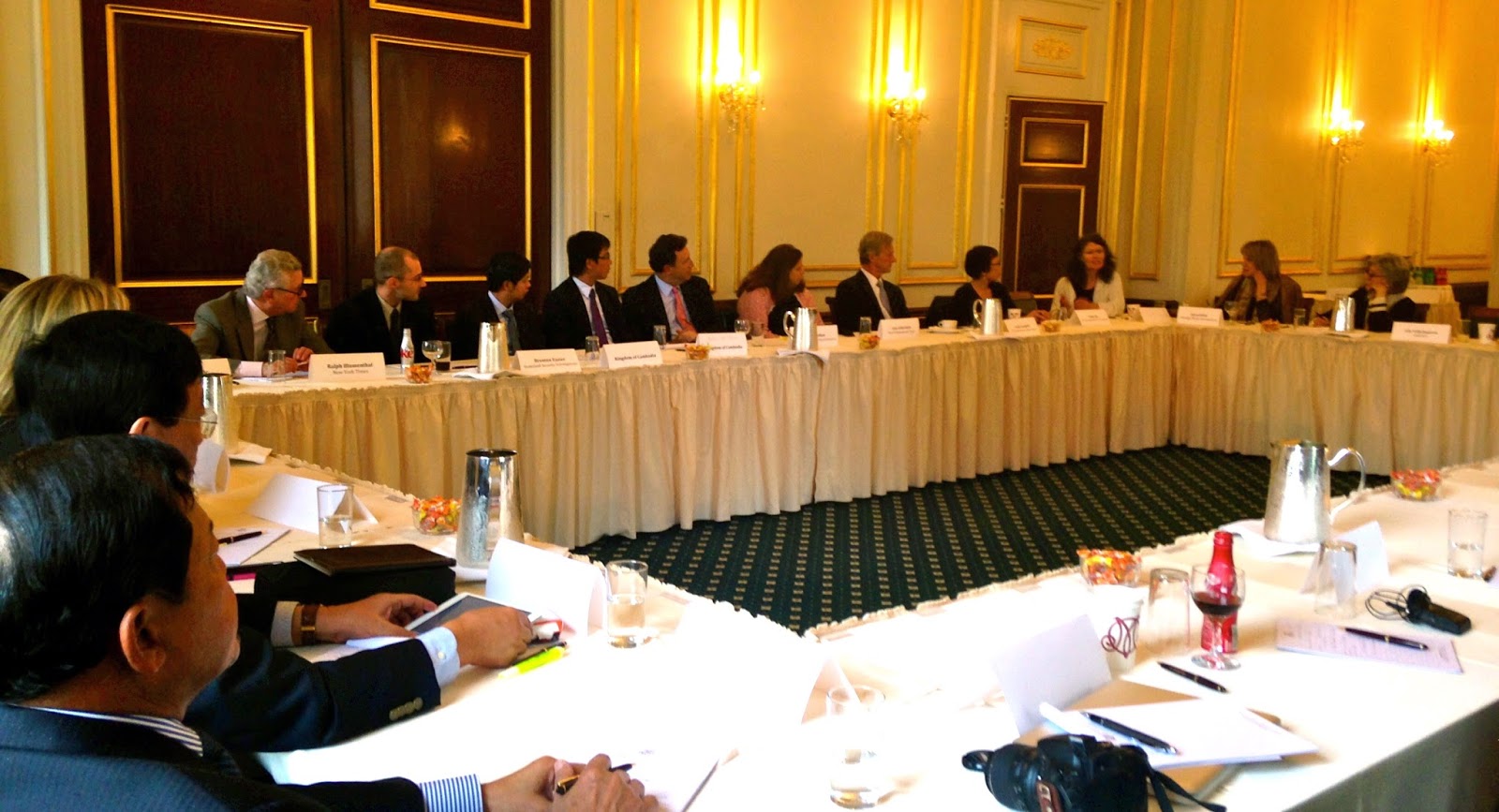
Cambodian officials continuing their efforts to repatriate a group of statues looted during the country's civil war joined the Antiquities Coalition on May 8 for a discussion of cultural racketeering in New York. Led by Deputy Prime Minister Sok An, Secretary of State Chan Tani, and Director General of the Ministry of Culture and Fine Arts, Hab Touch, the delegation engaged a group of international experts in a wide ranging discussion about the problem of looting and the illegal trafficking in antiquities and told about efforts to return the 10th century sculptural group from the Koh Ker dynasty temple site at Prasat Chen. 
The Antiquities Coalition's Cultural Racketeering Roundt-
able in New York on May 8, 2014.  Photo Credit: The 
Antiquities Coalition

Antiquities Coalition team members Deborah Lehr, Peter Herdrich, Katie Paul, and Tess Davis, an archaeologist and advocate of Cambodian cultural heritage organized the roundtable. Experts with broad international experience from diverse backgrounds in archaeology, museums, government, and business contributed to a conversation about global solutions to a global problem. The discussants included:
  • Journalist Ralph Blumenthal of the New York Times, who commented on his coverage of the
    story of the repatriation efforts and how the media has contributed to a broader public understanding of the issues. He and his colleague Tom Mashburg have been in front of the story from its inception, including the recent developments that
    Christie's, Sotheby's, and the Norton Simon Museum in California are returning sandstone statues from the Prasat Chen temple to Cambodia.
  • Larry Coben, the founder of the Sustainable Preservation Initiative, who gave a comparative perspective with a review of his work in Peru. SPI seeks to preserve the world’s cultural heritage by providing sustainable economic opportunities to poor communities where endangered archaeological sites are located. SPI believes the best way to preserve cultural heritage is by creating or supporting locally owned business whose success is tied to that preservation, a paradigm that could have great success in Cambodia.
  •  Rory Hunter, the owner of the Song Saa resort in Cambodia, who talked about the importance of an economic component in heritage preservation in providing opportunities for people around sites as well as in protecting them.
  •  The Ambassador of Cyprus, Mr. Vasilios Philippou, who commented on his country's experience in combatting looting and how challenging it is for countries facing economic difficulties to fight this global issue alone.
  • Cambodian Secretary of State Chan Tani, who agreed with Ambassador Philipou and talked about how governments, NGOs, and committed people around the world can join in the fight to help countries in crisis fight against cultural racketeering.
  • Lisa Ackerman of the World Monuments Fund, who endorsed the importance of inventories and accession records to provide baseline data on the material every country has discovered. *
Also providing insight were Sameh Iskander, the President of the American Research Center in Egypt, Joyce Clark from Heritage Watch International in Cambodia, Special Agent Brenton Easter of Homeland Security Investigations, and Robert Murowchick the Director of the International Center for East Asian Archaeology and Cultural History at Boston University. All commented on aspects of the illegal trade in antiquities. 

Left to Right: Antiquities Coalition Chairman, Deborah Lehr;
Cambodian Deputy Prime Minister, Sok An; Antiquities Coa-
lition Counselor, Tess Davis; and Antiquities Coalition Vice
Chairman, Peter Herdrich as Deputy Prime Minister Sok An 
addresses looting and cultural racketeering at the May 8th 
Roundtable in New York. Photo Credit: The Antiquities 
Coalition
Deputy Prime Minister Sok An summarized his perspective on cultural racketeering and the search for global solutions. He urged all to consider the three ideas he keeps in mind in his efforts to provide assistance – respect for local culture, for nature, and for communities. He endorsed the primacy of international and Cambodian law in solving disagreements and commented that since cultural racketeering is a multifaceted, international problem, Cambodia was pleased to have many allies in the international community, including all those present.

The roundtable discussion was held at the Metropolitan Club in New York. It is the second organized by the Antiquities Coalition, following a March Cultural Racketeering Roundtable at the Egyptian Embassy in Washington, DC marking the visit of Egyptian Minister of Antiquities Mohammed Ibrahim to sign a Public-Private Partnership with the Coalition to cooperate in fighting cultural racketeering in Egypt.


*The Antiquities Coalition is currently working with The Egyptian Ministry of Antiquities on extending inventory and accession record programs to museums and storage sites across the country.